
Report scope
This story uses “data center proposal” only as shorthand for the proposed zoning amendment. The available public record does not establish that a complete development proposal exists. Potential impacts are presented as unanswered questions or policy considerations—not as facts about a specific project.
At a glance
No company, developer, address, acreage, or application has been disclosed.
Every other Rochester zoning district would exclude the use.
Planning Board conditional-use approval would be required; the use would not be permitted automatically.
First reading August 4; public hearing scheduled for August 18.
The draft says the amendment would take effect if and when passed.
How the issue reached the City Council
The published Community Development Committee minutes reviewed for this story contain no data-center discussion.
Mayor Chuck Grassie raised the topic after reporting that interest had been expressed in a data center and in land within Rochester. He asked the committee what the City Council’s next step should be, and councilors agreed that more research was needed.
An agenda bill was submitted proposing a definition and zoning-table change. The agenda bill lists Mayor Chuck Grassie in the “Dept. Head Signature” field, is dated July 29, and contains no committee sign-off.
The City Council is scheduled to introduce the amendment and refer it to a public hearing.
A public hearing is scheduled for August 18, when residents may offer input. The Council could adopt, amend, postpone, refer, or reject the amendment.
What the July 9 minutes actually say
The minutes call this a “newer issue in Rochester and New Hampshire.” They say residents had spoken up, there was interest in land within Rochester, and the mayor wanted feedback on the Council’s next step. The committee concluded that it needed more information to “ensure the right choice for Rochester residents.”
The minutes do not name the interested party, site, landowner, utility, power or water requirement, or development schedule. They also do not record a recommendation for or against a data center.
What the proposed ordinance would do
- Create a new zoning definition. A data center would include a building, facility, campus, or portion of one used primarily to house, operate, manage, process, store, transmit, or distribute digital data through servers, networking equipment, and related infrastructure.
- Include supporting systems. Mechanical and electrical systems, cooling, backup generation, energy storage, security, and utilities needed for continuous operation would fall within the definition. A server room that merely supports another principal use—such as an office, school, hospital, factory, or store—would not.
- Explicitly include hyperscale facilities. The definition covers large-scale cloud computing, artificial intelligence, and enterprise computing facilities with extensive server capacity, high electrical demand, and significant supporting infrastructure.
- Limit the use to one district. The zoning table would show a dash—meaning not allowed—in every district except RI. RI would show “C,” meaning conditional use.
- Require discretionary review. A future applicant would need a Conditional Use Permit from the Planning Board, ordinarily reviewed together with a site plan.
- Take effect upon passage. The August 4 meeting is only the first reading; the proposal is scheduled for an August 18 public hearing.
“RI” means Recycling Industrial
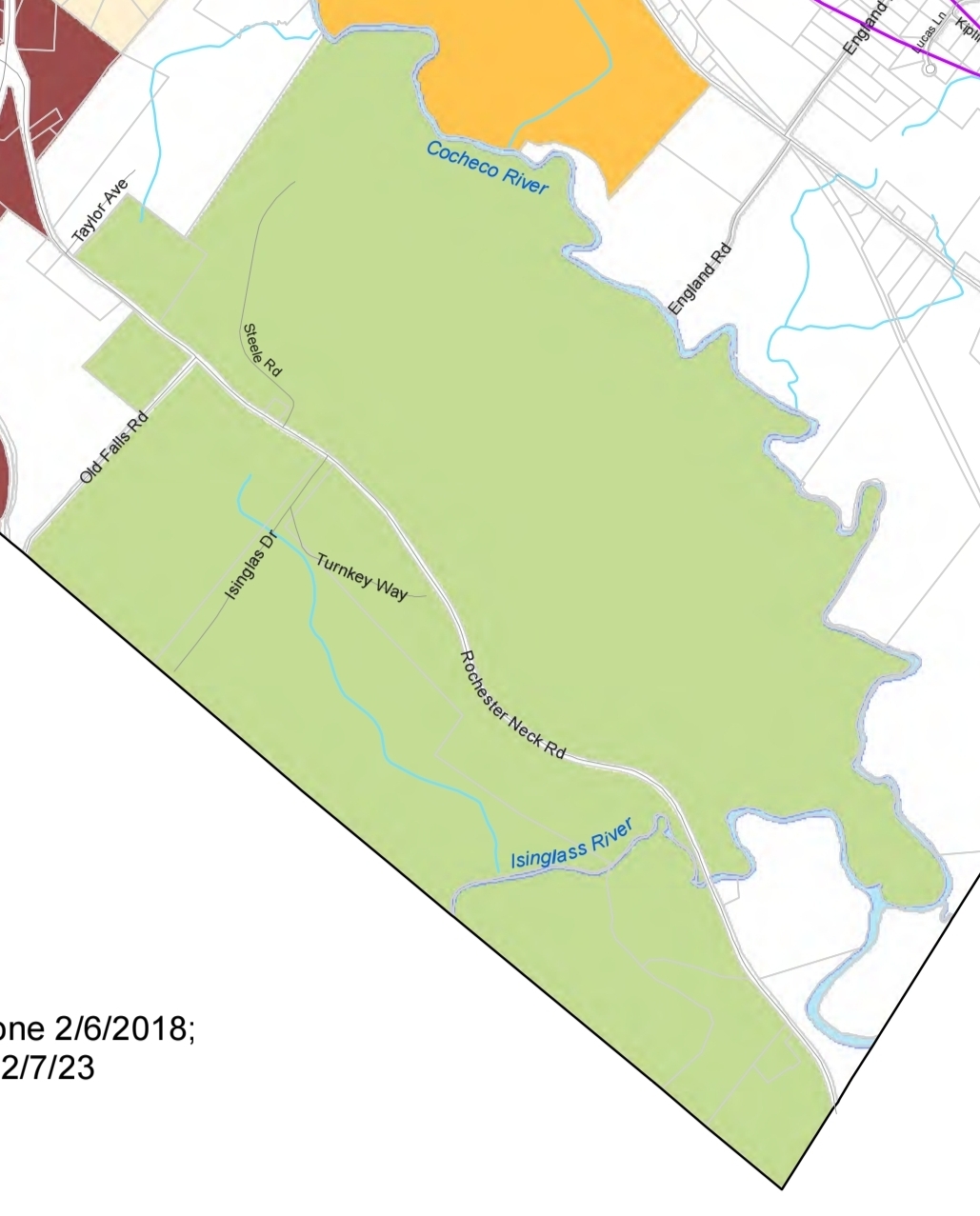
RI is not shorthand for all industrial land. Rochester describes the Recycling Industrial District as intended for large-scale, land-intensive landfill, recycling, and junkyard-type uses, including facilities off Rochester Neck Road. The code says these uses should be buffered and designed to reduce adverse effects on nearby homes.
The draft excludes General Industrial, Granite Ridge, Highway Commercial, and every other district. Unless the ordinance changes later, only land zoned RI would be eligible for consideration.
Existing RI development standards
- Outside processing and storage generally must be screened from roads and neighboring residential property.
- The RI section’s 200-foot residential setback specifically applies to landfill, recycling, and junkyard operations. The draft does not say that setback would automatically apply to a data center.
- Because a data center would be conditional, the Planning Board could impose greater setbacks, screening, landscaping, building-size limits, operating restrictions, traffic controls, and other justified performance standards.
How a future application would be reviewed
The Planning Board grants conditional uses after a public hearing. When an application also requires site-plan review, Rochester ordinarily conducts the two reviews together. The applicant carries the burden of presenting enough evidence to prove compliance.
The Board must consider the following information when applicable to the case:
- Authorization: Is the use specifically authorized as conditional?
- Zoning purpose: Does it fit the purpose and intent of the ordinance?
- Master Plan: Is it consistent with the plan’s purpose and intent?
- Compatibility: Does it fit the dimensions, uses, and design of the surrounding area?
- Streetscape: Would it harm the quality of the streetscape?
- Resources: Would it significantly harm natural, scenic, historic, or cultural resources?
- Public facilities: Would it place an undue burden on water, sewer, stormwater, fire, police, streets, or schools?
Conditions the Planning Board could impose
- Larger front, side, or rear setbacks.
- Additional screening and landscaping.
- Changes to exterior building features.
- Stricter limits on building size, footprint, or lot coverage.
- Limits on methods and hours of operation.
- Controls for driveways, traffic, parking, and loading.
- Other site-appropriate performance standards.
Conditions must be written. The Board may require security or bonding and may place conditions on the plans or record them at the Registry of Deeds. A conditional-use decision may be appealed to Superior Court.
Existing citywide standards would also apply
Rochester’s general performance standards require uses to prevent, eliminate, minimize, or mitigate objectionable impacts and keep them from extending beyond property lines.
Steady industrial noise at a lot line is currently limited to 70 dBA during the day and 60 dBA at night.
Emergency generators and certain other equipment are exempt from the ordinance’s noise provisions during emergencies, testing or other planned operation.
Exterior lighting must avoid glare and objectionable light trespass.
Heat may not be discernible at the lot line.
Industrial emissions must meet applicable New Hampshire Department of Environmental Services standards.
Ground-transmitted vibration may not be discernible without instruments beyond the lot line.
Hazardous or toxic materials may not be discharged in a way that degrades groundwater or surface water.
Operations may not interfere with equipment beyond the property.
Handling must comply with applicable state and local standards.
What is known—and what is not
Supported by the public record
- There has been interest in a data center and in land within Rochester.
- The city is proposing zoning rules before a project is approved.
- The definition includes hyperscale, cloud, AI, and enterprise-computing facilities.
- Only the Recycling Industrial District would be eligible.
- A Planning Board Conditional Use Permit would be required.
- The amendment is scheduled for an August 18 public hearing.
Not disclosed or established
- Company, developer, operator, or investor.
- Property address, tax map, acreage, or landowner.
- Electrical load, utility connection, or transmission upgrades.
- Cooling technology, water use, wastewater, or water source.
- Building size, server capacity, generators, batteries, or fuel storage.
- Construction schedule, jobs, assessed value, tax revenue, or incentives.
- Noise, traffic, emergency-response, decommissioning, or environmental studies.
Important policy questions the draft leaves open
The amendment answers what a data center is and where one may be considered, but it creates no dedicated technical standards. Rochester’s general rules would apply, yet councilors and residents may want to decide whether more specific protections should be written before an application arrives.
- Why was the RI District selected, and which RI parcels are realistically developable?
- Should a minimum separation be required from homes, schools, waterways, or recreation areas?
- Should applicants disclose maximum electrical demand and all needed substations, transmission lines, or upgrades?
- Should applicants disclose cooling methods, maximum daily water use, water source, wastewater impacts, and drought plans?
- Should there be a data-center-specific noise standard for cooling equipment and low-frequency sound?
- Should generator testing be limited by time, duration, frequency, or notice?
- Should the city require air-emissions estimates, fuel-storage details, fire-suppression plans, and battery-safety documents?
- Should a decommissioning plan and financial security be mandatory?
- Should jobs, tax revenue, infrastructure costs, and public-service impacts receive independent verification?
- Should the city require third-party technical review at the applicant’s expense? State law allows reimbursement for reasonable third-party review in qualifying cases.
Why the proposal is narrower than it may appear
This is not a development agreement, tax agreement, utility agreement, site plan, or environmental permit. It is a land-use classification. Passage would open a legal pathway to apply in the RI District, but an applicant would still have to prove compliance through the Planning Board and obtain other applicable permits.
What residents should watch at the upcoming meetings
August 4: first reading
- Whether councilors identify an interested company, landowner, or general location.
- Why the amendment was introduced directly and whether planning staff, the Planning Board, Codes and Ordinances Committee, utilities, or emergency services reviewed it.
- Whether councilors propose additional technical standards.
- Whether the August 18 hearing details are confirmed.
August 18: public hearing
- Changes to the definition or eligible zoning district.
- Whether data-center-specific conditions are added.
- Whether the Council adopts, amends, postpones, refers, or rejects the ordinance.
- Whether a named project is disclosed or remains separate from the zoning discussion.
Questions residents can ask in plain language
“Is there a company or property behind this amendment? If so, who and where?”
“Why is RI the preferred district, and how close are eligible parcels to homes?”
“Will the city require power, water, noise, generator, fire-safety, and decommissioning studies before approval?”
“Who pays for independent technical review and any public infrastructure upgrades?”
“What public benefits—jobs, tax base, infrastructure, or community investment—would be verified rather than projected?”
Bottom line
Rochester is writing the rules before a named project reaches the public approval process. That is the right time for residents to pay attention—but the available record does not support saying that a data center has been approved, a particular company has selected a site, or construction is imminent.
The proposal matters because it would make a data center legally eligible for consideration in the Recycling Industrial District. Approval would still be discretionary and evidence-based through conditional-use and site-plan review. The unresolved question is whether Rochester should rely on general standards or adopt detailed, data-center-specific protections now.
Sources and research notes
- Rochester City Council packet and agenda for August 4, 2026 , especially packet pages 194–201 and agenda pages 1–3.
- Community Development Committee minutes index , including July 9, 2026 draft minutes reproduced in the Council packet.
- Rochester Zoning Ordinance, Article 21: Conditional Uses .
- Rochester Zoning Ordinance, Article 7: Industrial Zoning Districts .
- Rochester Zoning Ordinance, Article 28: Performance Standards .
- Community Development Committee final minutes, June 11, 2026 .
- New Hampshire RSA 674:16, local zoning authority .
- New Hampshire RSA 676:4, Planning Board procedures .
- New Hampshire RSA 676:4-b, third-party review and inspection .
Research limitations
This story reviews the August 4 packet, the published July 9 and June 11 Community Development Committee records, Rochester’s zoning code, and relevant New Hampshire planning statutes available as of August 1, 2026. Records may be updated or supplemented. Nothing here confirms a private negotiation or application that has not been publicly disclosed.
Disclosure
This report was assembled with assistance from artificial intelligence using public records and the supplied community map. Every effort was made to separate confirmed facts from unanswered questions and analysis. If an error or newly released document is identified, please contact Life in the Lilac City so the story can be corrected or updated.