
Full detailed recap
Thursday night’s Public Works & Buildings Committee meeting focused heavily on Rochester’s drinking-water system and long-term regional resilience. The committee heard an update on a state study examining emergency connections among Seacoast-area water systems, reviewed three possible Rochester connections, discussed the century-old water main serving part of Lebanon, Maine, reviewed the city’s 2025 water-quality report and received a detailed update on the Old Dover Road/Tebbetts Road mini-roundabout. Public Works also reported progress on The Ridge II, Sullivan Farm Drive, Landry Lane and a Brock Street guardrail.
Main outcomes
- A state planning study identified three possible emergency water connections involving Rochester: Farmington, Somersworth and Dover. These are long-range concepts, not approved construction projects.
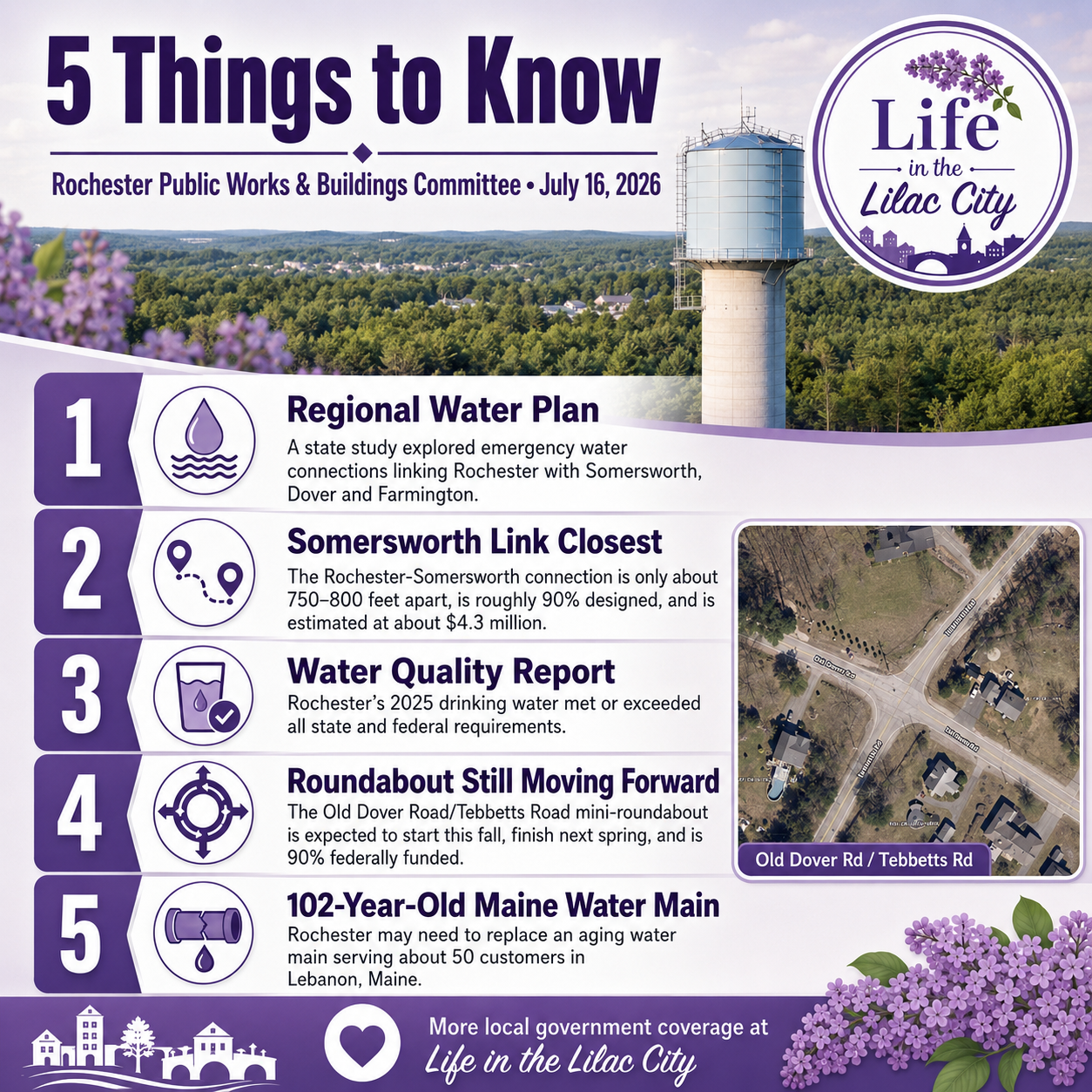
- The Rochester–Somersworth connection is the shortest and most advanced option. It would require roughly 750 to 800 feet of connecting main, has an estimated cost of $4.3 million and was described as approximately 90% designed for possible inclusion in Rochester’s FY 2028 capital plan.
- Rochester’s 2025 Consumer Confidence Report says the public water system met or exceeded all state and federal drinking-water requirements after roughly 2,200 tests covering more than 175 compounds.
- Public Works said construction of the Old Dover Road/Tebbetts Road mini-roundabout was expected to begin in fall 2026 and finish in spring 2027. The construction estimate was approximately $1.5 million, with 90% expected from the federal Highway Safety Improvement Program.
- Sullivan Farm Drive reconstruction was expected to begin shortly after Labor Day; Landry Lane turning-area work was complete; the city hoped to advertise the public-infrastructure portion of The Ridge II later in the fall; and a Brock Street guardrail repair remained in progress.
Attendance and opening business
Chairman John Larochelle called the meeting to order. Committee members present were Councilors John Larochelle, David Walker, Donald Hamann and Kevin Sullivan, along with Mayor Charles W. Grassie Jr. Councilor Les Horne filled in for Councilor Daniel Fitzpatrick.
The committee unanimously approved the May 21, 2026 meeting minutes.
The meeting adjourned at approximately 6:55 p.m.
Public input
Councilor Susan Rice asked where residents could find the 2025 Drinking Water Consumer Confidence Report and whether it had been included with the meeting packet.
Director of City Services Peter Nourse said the report had been posted online in March, announced through the city’s notification system and linked on water bills. No other members of the public spoke during the general public-input period.
Regional drinking-water interconnection study
The New Hampshire Department of Environmental Services commissioned Underwood Engineers to update a long-range study of emergency water-system connections across the Seacoast region.
The study covers 24 communities and looks 20 to 50 years into the future. Presenters stressed that it is a planning document, not a state mandate requiring Rochester or any neighboring community to build a particular project.
The basic goal is resilience. A community could temporarily send water to a neighboring system during a drought, contamination event, major equipment failure, source-water problem or other emergency. Some connections could eventually support routine water sharing, but emergency mutual aid is the immediate focus.
The regional numbers showed why the issue is more complicated than simply comparing total supply with average demand:
- Dependable regional supply was estimated at approximately 33 million gallons per day.
- Average demand was approximately 17 million gallons per day.
- Summer demand was approximately 23 million gallons per day.
Although the region appears to have enough water overall, that capacity is not evenly distributed. Individual systems can still face localized shortages, contamination, drought, treatment limitations or transmission problems. An available source in one community cannot help another unless the systems have a physical connection and compatible operating arrangements.
The study also examined consolidation opportunities for smaller public water systems that must meet the same regulatory standards as larger municipal utilities but may have fewer technical and financial resources.
Rochester’s position in the regional network
Rochester is important to the regional concept because it has both groundwater and surface-water resources and sits at a relatively high elevation. That elevation could allow Rochester to send water toward some lower-elevation communities with little or no pumping, depending on the destination, desired flow and storage-tank conditions.
The study credited Rochester with approximately:
- 3.89 million gallons per day of dependable capacity when the Round Pond augmentation project is included.
- 2.25 million gallons per day without the Round Pond augmentation.
The Cocheco Well was not included in those dependable-capacity figures.
Engineers said Rochester is already pursuing source and treatment improvements outside this interconnection study. The regional connections would serve as an additional “Plan B,” not a substitute for maintaining and improving Rochester’s own system.
The study identified 11 interconnection projects that rose to the top regionally. Some were described as lower-cost “low-hanging fruit,” while others would cost more but provide a greater regional benefit.
Three possible Rochester interconnections
The study examined three conceptual connections involving Rochester. All were designed at a high level as bidirectional facilities, meaning water could move either way depending on the emergency, available supply, system pressure, water quality and operating agreement.
None of the three projects received construction approval at this meeting.
Rochester–Farmington
The Farmington concept would include:
- Approximately 7,500 feet of new water main along Route 11.
- A pump station.
- Chemical-treatment or chemical-feed equipment.
- Metering and related controls.
- An estimated cost of approximately $10.8 million.
Farmington’s system operates at a higher hydraulic elevation, so pumping would be required for Rochester water to move into that system at the planned service level.
The connection could give both communities another emergency option, but it would require substantially more pipe and infrastructure than the Somersworth concept.
Rochester–Somersworth
The Somersworth connection was described as the shortest and most advanced of Rochester’s three concepts.
The two systems are only approximately 750 to 800 feet apart near Old Dover Road. The concept included:
- A connecting water main.
- Metering.
- Possible chemical-feed equipment.
- A possible pump station.
- An estimated cost of approximately $4.3 million.
Engineers said some water transfer may be possible without a pump because of Rochester’s elevation. A pump would likely be needed to deliver larger volumes or fill Somersworth’s storage tank.
The design was described as approximately 90% complete, and Rochester had placed the concept in the FY 2028 capital-improvement planning process.
Important unresolved issues include:
- How costs would be divided.
- Whether Somersworth wants to move forward.
- The desired emergency flow and operating rules.
- Differences in water chemistry and treatment.
- Ledge and difficult construction conditions.
- Work within or near a state-controlled roadway and the associated NHDOT requirements.
This connection would also give Rochester indirect access to Dover because Dover and Somersworth already have an interconnection.
Rochester–Dover
The Dover concept would be a larger and more expensive project, but presenters described it as having a high regional benefit.
The concept included:
- Approximately 9,400 feet of 16-inch water main along Rochester Neck Road.
- A pump station.
- Chemical-feed equipment.
- Metering and controls.
- An estimated cost of approximately $12.7 million.
A direct Rochester–Dover connection could link Rochester more firmly to larger systems farther south and strengthen the broader north-to-south regional network.
Water quality, governance and cost sharing
Building a pipe would not by itself create a workable regional system.
The participating communities would also need agreements covering:
- Who may request water and under what circumstances.
- How much water each system must make available.
- Whether water would be sold only during emergencies or under broader conditions.
- How construction, maintenance and operating costs would be divided.
- Who controls pumps, valves and metering.
- How communities would manage differences in water chemistry, disinfection and corrosion control.
The fluoridation difference between Rochester and Somersworth was specifically noted. Rochester fluoridates its water; Somersworth does not. Rochester properties currently supplied through Somersworth’s consecutive system receive nonfluoridated water.
Public Works said the next practical step is to begin or continue conversations with the neighboring communities, determine their level of interest and refine the conceptual projects around real operating needs.
Lebanon, Maine water main is 102 years old
Rochester provides public water to approximately 50 customers in Lebanon, Maine, through a franchise arrangement dating to 1924.
Public Works said approximately one mile of water main is located on the Maine side of the border. The principal main is now approximately 102 years old and was described as being in very poor condition.
Some galvanized pipe remains in the system. Public Works also identified another section of approximately 300 feet that it would like to replace.
The replacement was proposed for Rochester’s FY 2029 capital-improvement plan, but major questions remain:
- The city did not yet have a complete project estimate.
- Rochester and Lebanon had not agreed on how costs would be divided.
- Public Works had not yet formally approached Lebanon’s five-member governing board.
- The communities would need to address ownership, responsibility and long-term operating arrangements.
Nourse said the pipe may not fail immediately, but its age means the communities need to begin planning now rather than wait for an emergency.
The longstanding arrangement also includes a $30 annual payment per hydrant from Lebanon to Rochester, totaling approximately $1,800 per year. Public Works previously noted that this amount had never been changed.
2025 Drinking Water Consumer Confidence Report
Public Works presented Rochester’s annual Consumer Confidence Report, also called the Annual Water Quality Report. Federal law requires public water systems to provide customers with this yearly summary.
Rochester’s system serves approximately 25,000 people in Rochester and part of Lebanon, Maine.
The 2025 report included the following system statistics:
- Approximately 2,200 drinking-water tests.
- Testing for more than 175 compounds and contaminants.
- Approximately 8,000 service connections.
- Approximately 150 miles of water main.
- Approximately 730 million gallons of water produced through the surface-water plant and groundwater source.
Public Works said Rochester’s drinking water met or exceeded all applicable state and federal requirements in 2025.
The city was also classified as a lead-free system. That classification reflects Rochester’s service-line inventory and regulatory status; residents with questions about plumbing inside an individual home can still contact the Water Treatment Facility for guidance.
The report describes testing for substances and water-quality indicators that include bacteria, turbidity, disinfection byproducts, lead and copper, iron, manganese, nitrates, volatile and synthetic organic compounds, inorganic compounds, PFAS, alkalinity and other regulated or monitored parameters.
The report is available on the city website. Residents may also request a printed copy from the Water Treatment Facility.
Old Dover Road/Tebbetts Road mini-roundabout
Public Works provided a detailed response to a resident petition opposing the planned mini-roundabout at Old Dover Road and Tebbetts Road.
The city said the intersection carries approximately 15,000 vehicles per day. Traffic speed, limited sight distance and the current two-way stop configuration make it difficult and hazardous for drivers to enter or cross Old Dover Road from Tebbetts Road.
Public Works cited:
- More than 60 crashes during the past decade.
- Two fatalities since 2018.
- A 2020 NHDOT Road Safety Audit that examined short- and long-term improvements.
The city said the short-term recommendations had been completed and the selected long-term alternative remained a mini-roundabout.
Why a four-way stop was not selected
A four-way stop was evaluated. Public Works said the available roadway area would not properly accommodate turning trucks without additional widening. Large trucks could track into the space occupied by stopped passenger vehicles.
Stopping Old Dover Road traffic could also create lengthy queues at an intersection processing approximately 15,000 vehicles each day.
Why a traffic signal was not selected
A traffic signal was also evaluated, but the traffic volumes and warrants did not support installing one.
Public Works said a signal could create long queues and would not provide the same speed-reduction and severe-crash benefits as the selected roundabout.
Response to the petition
The petition raised seven primary concerns. Public Works responded as follows:
1. Trees
Petition concern: Healthy trees, including trees more than 100 years old, would be removed.
City response: Some trees had already been trimmed as part of short-term safety work. The project may require trimming or removing a small number of trees on Tebbetts Road to provide clearance for relocated power lines.
2. Private property
Petition concern: The city would need land from at least four homes.
City response: The project footprint will remain within the existing public right of way. No property acquisition is required.
3. Utility poles and power lines
Petition concern: Power lines would be moved across the street to several new locations.
City response: Utility facilities will be adjusted where necessary. Moving poles will also eliminate existing sight-distance problems. Public Works said this utility relocation is not a city construction cost.
4. Nearby wells
Petition concern: Construction could affect several private wells.
City response: The city is aware of one well near the existing roadway. Public Works said the project will not affect it.
5. Construction duration and access
Petition concern: The project would take years and create prolonged disruption.
City response: The project was in final design. Public Works expected construction to begin in fall 2026 and, if it started on schedule, finish in spring 2027. Temporary traffic-control measures would maintain access during construction.
6. Whether the project will reduce crashes
Petition concern: The mini-roundabout would not solve the intersection’s crash problem.
City response: Roundabouts reduce the number and severity of conflict points and force approaching vehicles to slow down. Public Works said the project should make the intersection safer and reduce speeds on all approaching roadway legs.
7. Cost to taxpayers
Petition concern: The project would cost taxpayers several million dollars.
City response: The construction estimate was approximately $1.5 million. Federal Highway Safety Improvement Program funds were expected to cover 90% of the cost, leaving a comparatively small local share.
Public Works said the need for a major improvement had been recognized since 2019 and that the city and state had held multiple meetings and considered public input before selecting the project.
No new committee vote was required. The project continued in final engineering, with Public Works expecting fall construction.
Other Public Works updates
The Ridge II
Public Works said a state-level veto or funding issue was not expected to stop The Ridge II project.
Coordination among the involved parties was improving. The city hoped to advertise the public-infrastructure portion of the work later in the fall, award the contract before the end of the year and complete most physical construction in 2027.
Sullivan Farm Drive
Public Works expected reconstruction of Sullivan Farm Drive to begin shortly after Labor Day and finish by the end of 2026.
The road serves a 15-home cul-de-sac. Planned work included:
- New subbase.
- New pavement.
- Drainage improvements.
- Possible ditch work.
- Possible sight-distance improvements.
Nourse said the department would return to the committee with options if the available funding proved insufficient.
Landry Lane
A resident had previously asked the city to improve the Landry Lane turning area because snowplows were damaging the center and delivery trucks and other large vehicles had difficulty turning.
Public Works reported that the city:
- Excavated the turning area.
- Installed new subbase.
- Installed new pavement.
- Increased the usable turning radius.
The resident later told the city he was pleased with the completed work.
Brock Street guardrail
Public Works followed up on a report involving a missing or loose guardrail end treatment on Brock Street.
A service request was opened, staff inspected the location and some corrective work had already been completed. Another component had been ordered. Public Works said the remaining condition was not considered an immediate hazard.
Action summary
- May 21 meeting minutes: unanimously approved.
- Regional drinking-water interconnection study: presentation and discussion only; no project was authorized.
- Rochester–Farmington, Rochester–Somersworth and Rochester–Dover concepts: no construction vote; staff will continue planning and discussions with neighboring systems.
- Lebanon, Maine water-main replacement: remained a future FY 2029 proposal; cost and cost-sharing were unresolved.
- 2025 Consumer Confidence Report: received as an informational presentation; no vote.
- Old Dover Road/Tebbetts Road mini-roundabout: no new vote; project continued through final design toward expected fall 2026 construction.
- Sullivan Farm Drive: reconstruction expected to begin after Labor Day.
- Landry Lane: work reported complete.
- Brock Street guardrail: follow-up repair remained pending.
What to watch next
- Whether Rochester and Somersworth agree on the scope, financing and operating rules for an emergency connection.
- Whether the Rochester–Somersworth project remains in the FY 2028 capital plan and advances from its approximately 90% design stage.
- Whether Rochester begins formal discussions with Lebanon, Maine, about replacing the 102-year-old main and dividing the cost.
- Whether Old Dover Road/Tebbetts Road construction begins in fall 2026 and remains on schedule for spring 2027 completion.
- Whether Sullivan Farm Drive reconstruction begins shortly after Labor Day and stays within the available budget.
- Whether The Ridge II public-infrastructure work is advertised and awarded before the end of 2026.
- Completion of the remaining Brock Street guardrail work.
Primary sources
Read the official documents and watch the full meeting to check the recap against the source material.
Disclosure and corrections
This recap was created with assistance from artificial intelligence using the official Public Works & Buildings Committee agenda packet and an auto-generated meeting transcript. AI and automated transcripts can make mistakes, particularly with names, quotations and technical terminology.
Readers who identify an error or missing context are encouraged to contact Life in the Lilac City so the information can be reviewed and corrected.
Sources: Rochester Public Works & Buildings Committee agenda packet, meeting video and auto-generated transcript for July 16, 2026, and the City of Rochester’s 2025 Water Quality Report.
About our editorial process